
If the Council of Tours hadn’t met in 567 then we probably wouldn’t have had Twelfth Night. That gathering of learned churchmen decided (among other ecclesiastical matters) that the period between Christmas Day and Epiphany (6 January) should be seen as part of the celebration, thus giving us the Twelve Days of Christmas.
There’s a bit of variation on how those days are counted. If Christmas Day is the first of the twelve days, then Twelfth Night would be on 5 January – the eve of Epiphany. If 26 December, is the first day, then Twelfth Night and Epiphany coincide on 6 January. You pays your money and you takes your choice, about what day you take down your Christmas decorations.
During the Victorian era it became seen as bad luck to leave up decorations after Twelfth Night. Candelmas (2 February) was another date mentioned. That’s 40 days after the birth of Jesus. Our late Queen left them up to 6 February, the date her father died in 1952. During the pandemic we decided it made sense to leave the lights up at least until winter was over to cheer everything up. If you’re really interested you can read lots more about this topic here.
The history of Twelfth Night celebrations needs a whole post to itself and I’ll get round to that one day, I hope. But another consequence of the Council of Tours was the arrival many centuries later of a song you’ll either love or hate. The earliest known version of The Twelve Days of Christmas first appeared in a 1780 children’s book called Mirth With-out Mischief. (A first edition of that book sold for $23,750 at a Sotheby’s auction in 2014, but you can also buy a digital copy on Amazon). The song may well have been designed as a ‘memory and forfeits’ game, where the players sang the song until someone forgot one of the gifts and was punished by having to do an embarrassing forfeit.
A large number of different melodies have been associated with the song, of which the best known is derived from a 1909 arrangement of a traditional folk melody by English composer Frederic Austin.
However, some have suggested that it is a song designed to help Christians learn and pass on the tenets of their faith while avoiding persecution. For instance: the two turtle doves represent the Old and New Testaments, the three French hens stand in for Faith, Hope and Charity, and the six geese a-laying refer to the six days it took to create the world. You can see the whole list below.
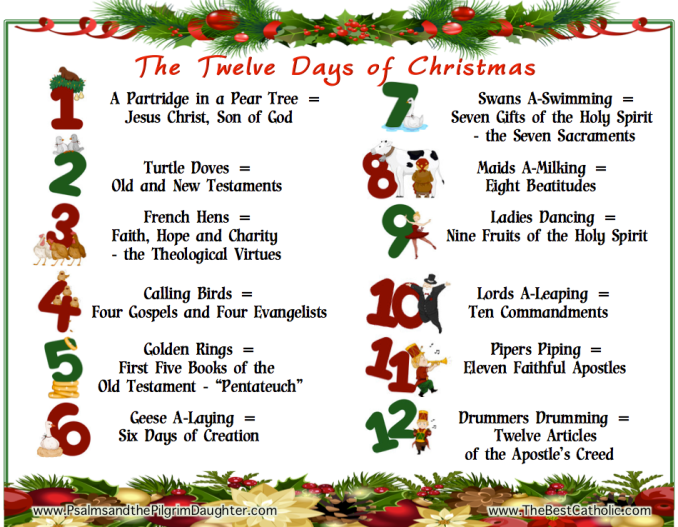
Most sensible folk would see this as a pretty long winded way of passing on the basics of religion, and the theory is generally dismissed. Still doubtful? Well, if you really need to remember that the Apostle’s Creed has twelve points of doctrine then just visualise twelve drummers drumming.
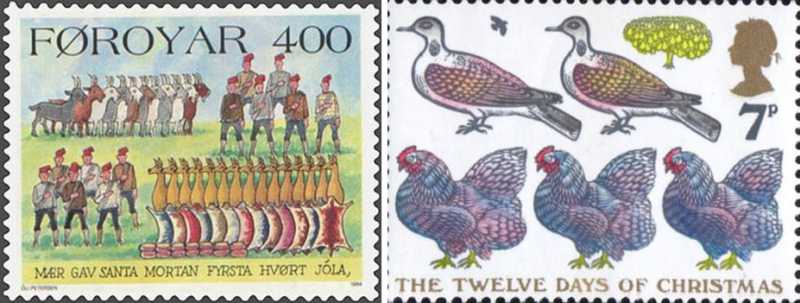
The Post Office decided to celebrate the song in 1977 with David Gentleman providing the design for several stamps. On the right you can see the one of the first class stamps for that year with the pear tree (minus partridge), turtle doves and French hens. The current price of a first class stamp is £1.70 showing how the song may not have changed but times certainly have. On the left is one of two 1994 stamps from the Faroe Islands illustrating some of the items from their own Christmas counting song.
The gifts include: one feather, two geese, three sides of meat, four sheep, five cows, six oxen, seven dishes, eight ponies, nine banners, ten barrels, eleven goats, twelve men, thirteen hides, fourteen rounds of cheese and fifteen deer. Both stamps were illustrated by local cartoonist Óli Petersen.
Another annual tradition related to the song likely to turn up somewhere near you will be the recitation of a monologue published in 1998:
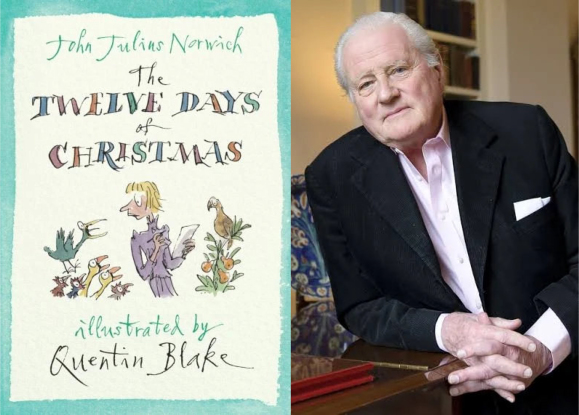
The Twelve Days of Christmas [Correspondence] by John Julius Norwich (he’s above on the right) was illustrated by Quentin Blake. It consists of letters written by Emily Wilbraham to her lover Edward who sends her each of the gifts mentioned in the song, resulting in mayhem in her village house and the breakdown of the lovers’ relationship with the sending of an injunction insisting that he desist.
It is quite funny the first few times you hear it, especially with a good reader, but it does pall after a while. Still, it’s a tradition – and that’s what Christmas is about. All together now – On the first day of Christmas my true love sent to me….
#Article